Learning a musical instrument takes patience, regular practice, and proper guidance. While music teachers provide valuable instructions during lessons, students often struggle to remember everything when practicing alone. Studiosoapp.com was created to address this challenge by connecting music teachers and students through a dedicated digital platform.
The Studioso music app focused on making everyday practice more organized and meaningful. Instead of relying entirely on handwritten notes or memory, students could follow practice objectives, monitor their progress, and stay connected with their instructors.
But what exactly did Studioso offer, and is the original platform still available today?
This article explores the history of Studiosoapp.com, its main features, how it supported music education, and what users should know about its current status.
What Is Studiosoapp.com?
Studiosoapp.com was the website associated with Studioso, a music education application developed to improve communication between teachers and students. The platform aimed to make music practice more structured by combining teacher instructions, practice tracking, and progress monitoring.
Unlike general learning applications, Studioso focused specifically on musical development. Its purpose was to help students make better use of their practice time while giving instructors a clearer understanding of their progress between lessons.
The original service was connected to Studioso LLC, an education technology startup based in Minnesota, United States.
Historical product information describes separate applications for teachers and students, allowing both sides to participate in a shared learning process.
Why Was Studioso Created?
One of the biggest challenges in learning music happens outside the classroom.
A student might understand a difficult violin passage during a lesson but struggle to repeat it correctly at home. Without clear instructions, practice can become frustrating, and the same mistakes may continue for days.
Studioso was designed to bridge the gap between music lessons and independent practice.
The platform gave teachers a way to communicate objectives and allowed students to follow those instructions throughout the week.
This approach recognized something important about music education: improvement depends not only on how long someone practices but also on what they practice and how carefully they approach it.
How Did Studioso Work?
The original Studioso platform used a connected teacher-and-student system.
Teachers could create practice objectives and assignments, while students could access those instructions through their own application. As students completed practice sessions, the system recorded their activity and made progress information available.
For example, a piano teacher could assign a particular scale, a short musical passage, and a technical exercise for the following week.
The student could then refer to those objectives during home practice instead of relying on memory.
The central idea was simple: teachers provided direction, students practiced, and both could follow the results.
This arrangement also offered instructors a clearer picture of how students were spending their time between scheduled lessons.
Main Features of Studiosoapp.com
Studioso included several tools intended to make music education easier to manage.
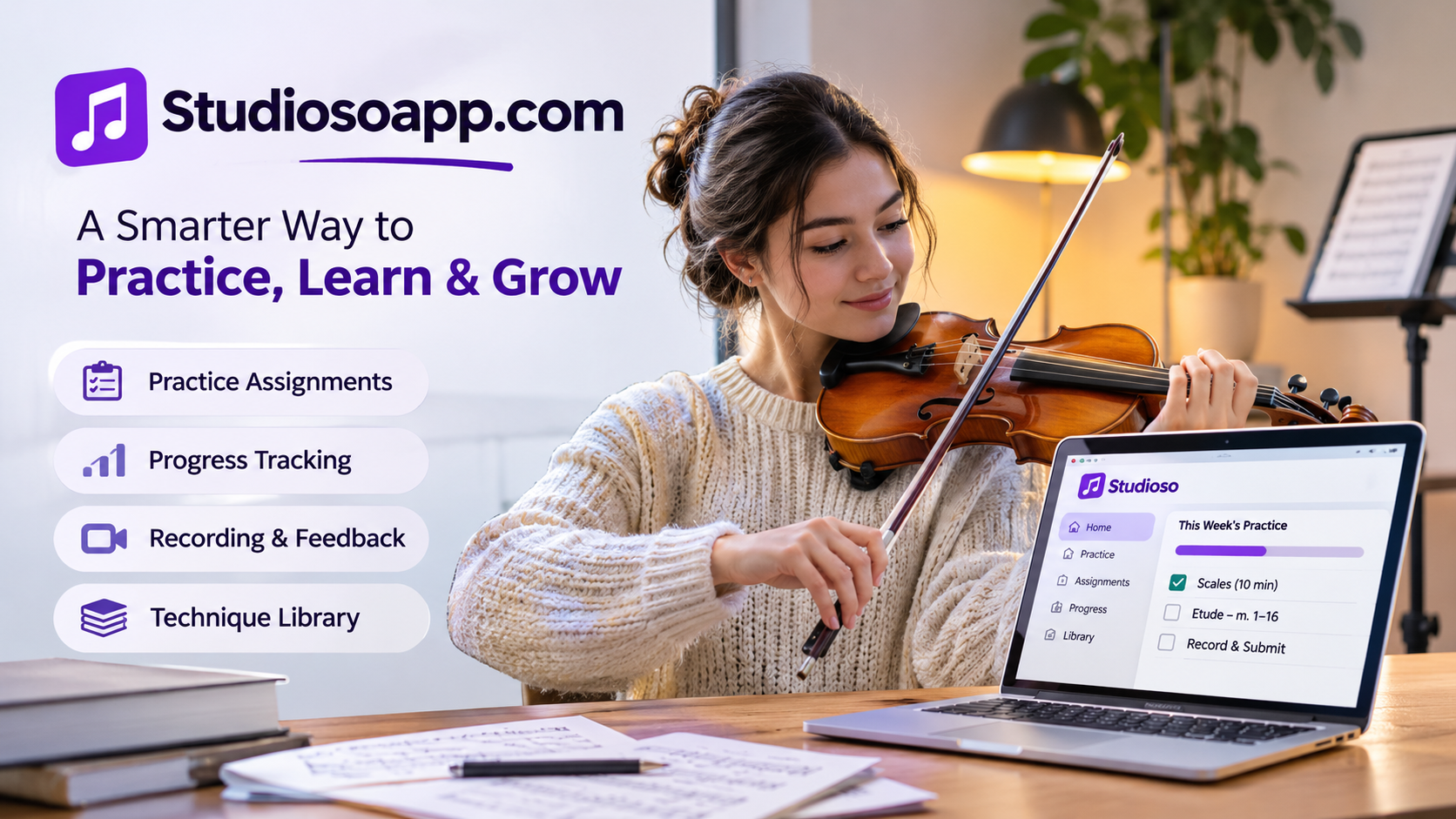
Its historical application descriptions identify guided practice, weekly objectives, progress tracking, recording assignments, and a dedicated Technique Library.
These features worked together to support more consistent learning.
Rather than functioning as a basic practice timer, the platform attempted to connect everyday practice with the goals established by a music teacher.
Guided Music Practice
Guided practice was one of the central features of Studioso.
Students could use their teacher’s instructions to understand which exercises needed attention and what they were expected to complete before the next lesson.
This was especially useful for beginners who might struggle to organize practice independently.
For instance, a guitar student learning chord transitions could focus on a specific exercise instead of repeatedly playing familiar songs.
Having a clear objective can make a short practice session more productive and reduce the uncertainty that often comes with learning something new.
Practice Tracking and Progress
Maintaining a consistent practice routine is important when learning an instrument. However, students do not always recognize how much work they have completed over several days.
Studioso addressed this through its Progress Tracker, which recorded completed practice sessions.
Historical descriptions of the student application also mention a built-in timer that helped organize practice time.
Teachers could use the recorded information to understand students’ practice habits and identify whether assigned objectives were receiving attention.
However, tracking practice time is not the same as measuring musical ability.
A student might practice regularly while still struggling with timing, tone, or technique. For that reason, tracking tools are most useful when combined with feedback from an experienced instructor.
Recording Assignments
Another notable feature of the original Studioso platform was its support for recording assignments.
Teachers could ask students to record particular exercises or musical performances as part of their practice work.
These recordings could then be reviewed and assessed through the teacher application.
Recording assignments gave instructors another way to evaluate progress outside scheduled lessons.
For students, listening to their own performances could also encourage greater attention to rhythm, accuracy, and musical expression.
A recording may reveal mistakes that are difficult to notice while playing. When paired with constructive teacher feedback, it can become a useful part of the learning process.
The Technique Library
Studioso also offered a Technique Library intended to help students improve their approach to instrumental practice.
The historical student app description identifies this library as a resource for learning effective practice techniques.
Its purpose was to support students who needed additional guidance while working independently.
For example, someone struggling with a difficult passage may benefit from understanding how to divide it into smaller sections, slow the tempo, and build accuracy gradually.
A resource like this cannot replace personalized instruction, but it can reinforce useful habits between lessons.
The full contents and current accessibility of the original Technique Library have not been independently confirmed.
Benefits for Music Teachers
Managing several music students can be demanding, particularly when each student has different abilities, schedules, and learning goals.
Studioso attempted to simplify this process by keeping practice objectives and progress information in one connected system.
Teachers could assign work, review practice records, and monitor student development without depending entirely on verbal updates during the next lesson.
The platform also supported student management and assignments for ensembles.
For instructors, this offered a more organized approach to tracking work completed outside the classroom.
It could also help teachers identify students who needed additional encouragement or clearer instructions.
Importantly, the application was designed to support teaching rather than replace the instructor’s professional judgment.
Benefits for Music Students
Students were another important part of the Studioso experience.
For beginners, the platform offered a way to remember practice instructions and follow a more organized routine. For experienced learners, tracking objectives could help maintain consistency while working toward more demanding musical goals.
The ability to monitor completed sessions could also provide a sense of achievement.
Small improvements are often easier to appreciate when students can see their progress over time.
Parents supporting younger musicians could potentially use shared practice goals to understand what their children needed to work on, although the historical records do not establish the availability of a dedicated parent account.
Ultimately, the app’s intended value was in helping learners use the time between lessons more effectively.
Who Founded Studioso?
Studioso was founded by Ocean Salazar-Ferrer, a young entrepreneur with a background in music.
According to a profile published by the University of Southern California’s Rossier School of Education, Salazar-Ferrer began playing the violin at an early age.
His experience as a musician helped him recognize the difficulties students encounter when practicing without immediate guidance.
The company was established in 2017 and developed its music education application with the goal of improving communication between instructors and learners.
Studioso also received recognition in Minnesota’s startup community.
In 2018, Studioso LLC won the Youth Division of the MN Cup entrepreneurship competition, according to the University of Minnesota’s Carlson School of Management.
This recognition provides historical evidence of the company’s development and its interest in improving music education through technology.
Was Studioso Available on Mobile Devices?
Historical company records indicate that Studioso was developed for iOS and Android devices.
The platform used separate teacher and student applications that could be connected for practice management and communication.
Archived descriptions of Studioso Student and Studioso Teacher also show that the software offered mobile practice tools, assignment features, and progress tracking.
This mobile-focused approach was relevant because students could access practice instructions while working with their instruments at home.
However, historical availability does not guarantee that these applications remain compatible with modern smartphones.
Anyone searching for the original app should verify its developer and availability through an official app store.
Was Studioso Free or Paid?
Historical listings describe Studioso as having both free features and subscription-based options.
An older company profile on Gust mentioned subscription plans ranging from approximately $2 to $4 per month. Archived teacher application information also referred to a freemium model with paid subscription options.
These details reflect historical pricing rather than a verified current offer.
The original platform’s active subscription plans, billing arrangements, and refund policies could not be confirmed in 2026.
Users should therefore avoid assuming that older prices or free-download descriptions still apply.
Is Studiosoapp.com Still Active in 2026?
An important question for anyone researching Studiosoapp.com is whether the original website and music application still operate.
As of November 2026, the operational status of the original Studioso service could not be independently confirmed.
An attempt to access the website did not return a working page during research.
Although historical company records and archived application listings confirm that Studioso existed, they do not establish whether new accounts can currently be created or whether old accounts remain accessible.
An inaccessible website does not automatically mean a business has permanently closed. Technical problems, changes in hosting, or discontinued services can all affect accessibility.
Without a reliable current announcement, it would be misleading to claim that the company has officially shut down or that its services are still running.
Is Studiosoapp.com the Same as Studioso AI?
People researching the original Studioso platform may come across a newer application with a similar name.
Studioso AI, associated with Studioso.dev, focuses on general academic learning rather than music practice management.
The newer application offers features such as document summarization, homework question scanning, lecture transcription, and digital study assistance.
Apple’s App Store identifies Liberty Global Development LLC as the developer of this newer application.
By comparison, the historical music education platform was associated with Studioso LLC.
No reliable evidence reviewed establishes that the two services belong to the same company or that the newer app replaced the original music platform.
This distinction is important because a similar product name does not necessarily indicate a shared developer, purpose, or ownership history.
Is Studiosoapp.com Safe to Use?
There is not enough current evidence to make a definitive judgment about the safety of the original Studiosoapp.com service.
Its historical development is documented, but its present website operations, account security measures, and customer support availability remain unverified.
Before downloading an application that uses the Studioso name, users should check the developer’s identity, recent updates, privacy policy, and permissions.
This is particularly important when an application involves children, teacher-student communication, or stored recordings.
Avoid entering personal information, payment details, or old account passwords into unfamiliar websites claiming to offer Studioso access.
Using official app stores and verifying developer information can help reduce unnecessary risks.
What Made Studioso Different?
Studioso’s original appeal was its concentration on one specific problem: helping music students practice effectively between lessons.
Many general productivity tools can track time, manage tasks, or store notes. Studioso attempted to bring several of these functions together around the relationship between a music teacher and a student.
Practice objectives came from instructors, progress records reflected students’ activity, and assignments connected independent work with classroom learning.
The platform treated music practice as an ongoing learning process rather than an isolated daily task.
This approach could be valuable for individual lessons, music studios, and ensemble instruction.
At the same time, its usefulness depended on teachers providing meaningful objectives and students following through with regular practice.
Technology could organize the process, but successful musical development still required commitment and thoughtful instruction.
What Should You Look for in a Music Practice App?
If the original Studioso application is no longer accessible, its historical features offer a useful starting point when comparing other music learning tools.
A good practice application should make it easy to set clear goals, organize exercises, record sessions, and review progress.
For students working with an instructor, the ability to share assignments or recordings can also be helpful.
Ease of use matters just as much as the feature list. An application that requires too much setup may distract students from the time they could spend playing their instruments.
Privacy is another consideration, especially when the platform stores recordings or information about younger learners.
The most useful app is one that supports an existing practice routine without making the learning process unnecessarily complicated.
Final Thoughts
Studiosoapp.com was associated with a music education platform created to improve communication, practice management, and progress tracking between teachers and students.
Its historical features included guided practice, weekly objectives, a Progress Tracker, recording assignments, and a Technique Library.
The company also gained recognition through Minnesota’s startup community, showing that the project had a documented history in educational technology.
However, the original service’s current availability remains uncertain, and its historical information should not be confused with the newer Studioso AI application.
The broader idea behind Studioso remains relevant: consistent practice works best when students have clear goals, useful feedback, and the support of a knowledgeable teacher.
For anyone exploring digital music education, that principle is more important than any single application.
Frequently Asked Questions (FAQs)
1. What is Studiosoapp.com?
Studiosoapp.com was the website associated with Studioso, a music education application designed to connect teachers and students. The platform supported guided practice, assignment management, communication, and progress tracking.
2. What was the main purpose of Studioso?
The main purpose of Studioso was to help music students practice more effectively between lessons. It allowed teachers to provide instructions and monitor student progress through a connected digital system.
3. Who created the original Studioso app?
The original Studioso platform was founded by Ocean Salazar-Ferrer and associated with Studioso LLC, a Minnesota-based education technology startup established in 2017.
4. Was Studiosoapp.com free to use?
Historical application descriptions mentioned free features and paid subscriptions. However, the current pricing and availability of the original service have not been verified.
5. Could students track their music practice with Studioso?
Yes. The original student application included a practice timer and Progress Tracker that helped students record completed sessions and monitor their practice activity.
6. Did Studioso support recording assignments?
Yes. Historical product descriptions indicate that teachers could create recording assignments for students and review submitted performances through the teacher application.
7. Was Studioso available for Android and iPhone?
Historical company information described versions for iOS and Android devices. However, the original application’s current availability and compatibility have not been independently confirmed.
8. Is Studiosoapp.com still working in 2026?
Its current operational status remains unconfirmed. The original website could not be accessed during research in November 2026, but this does not prove that the company has permanently closed.
9. Is Studiosoapp.com connected to Studioso AI?
There is no verified evidence establishing a connection between the original music education platform and the newer Studioso AI study application. They have different documented purposes and developer information.
10. Can beginners benefit from music practice applications?
Yes. Music practice applications can help beginners organize exercises, follow teacher instructions, and maintain consistent routines. However, they work best alongside appropriate musical instruction.
11. Is Studiosoapp.com a scam?
The available evidence does not establish that Studiosoapp.com is a scam. Its historical business activity is documented, but the current operational status and security of the original service could not be confirmed.
12. Can I recover an old Studioso account?
It is not known whether the original service still supports account recovery. Former users should look for verified official support information and avoid sharing their passwords with unrelated websites.