
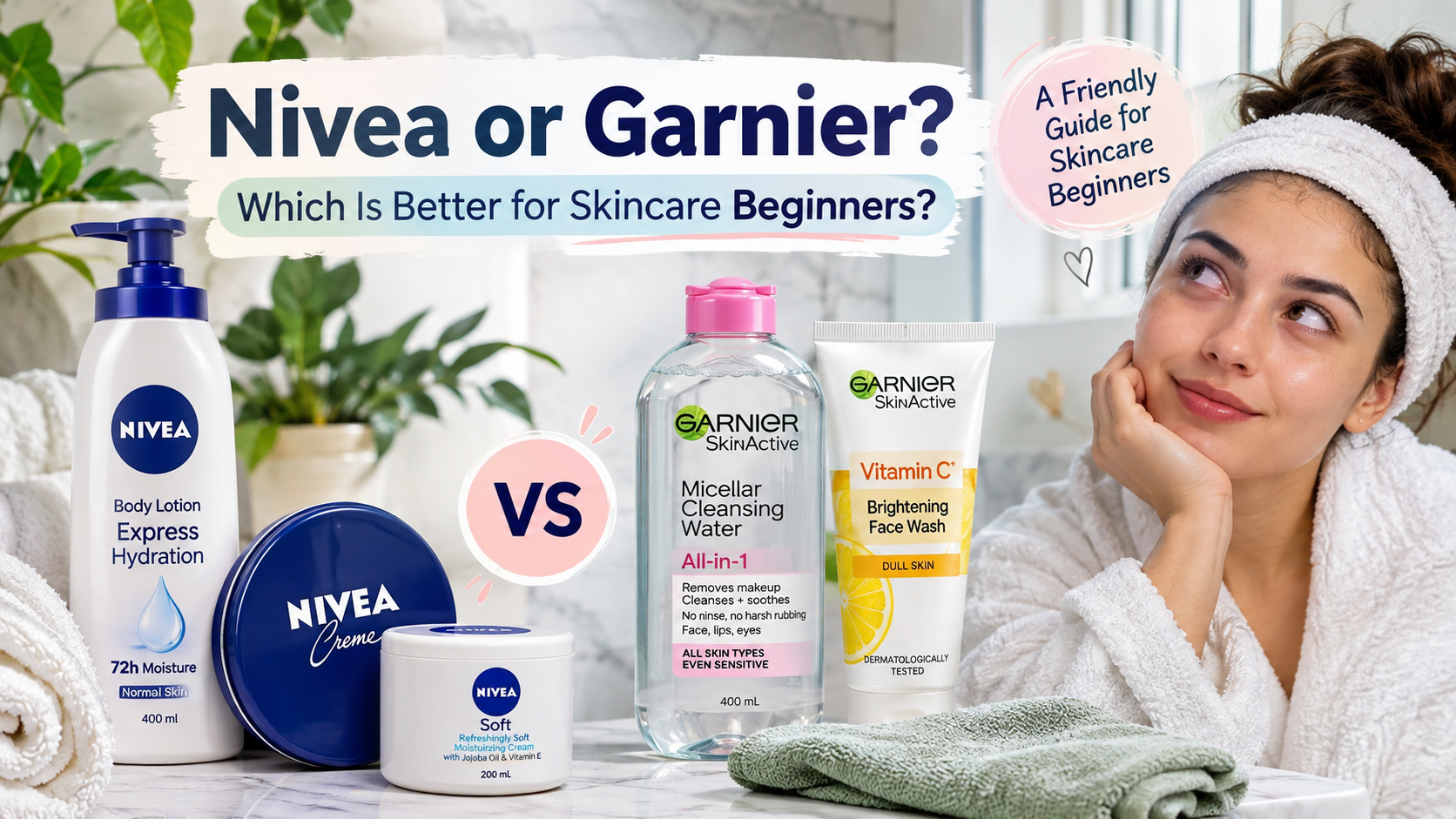
Starting a skincare routine can feel confusing, especially when you’re standing in front of shelves filled with cleansers, moisturizers, serums, and creams. Two familiar names you will probably notice are Nivea and Garnier. Both offer affordable skincare products, but which one makes more sense when you’re just starting?
If you’re wondering, “I’m a skincare beginner. Is Nivea a good starting brand compared to Garnier?”, the short answer is yes. Nivea can be an excellent starting point, particularly if your main goal is keeping your skin moisturized and comfortable. Garnier is also worth considering, especially if you’re interested in lightweight skincare, micellar cleansers, or products designed for specific skin concerns.
However, choosing between them isn’t simply about which brand is more popular. Your skin type, the ingredients in each product, and your daily routine matter much more.
Let’s look at what both brands offer and how to choose products without making your first skincare routine unnecessarily complicated.
Is Nivea Good for Beginners?
Yes, Nivea is a good skincare brand for beginners, especially for people who want straightforward moisturizing products without spending too much money.
Nivea has a long history in skincare and is particularly well known for its moisturizing creams. Products such as Nivea Creme and Nivea Soft are designed to help keep skin hydrated, making them familiar options for people looking for everyday skin comfort.
One reason Nivea appeals to beginners is that you don’t need to understand complicated active ingredients to start using a basic moisturizer. If your skin feels dry or tight after washing, an appropriately chosen Nivea moisturizer may help.
Still, not every Nivea product suits every face. Some traditional creams have rich textures that may feel too heavy on oily skin, while certain formulas contain fragrance that can irritate sensitive skin.
The important thing is to choose the right Nivea product rather than assuming every product from the brand will work for you.
Is Garnier Good for Beginners?
Garnier is another accessible choice for someone building a skincare routine for the first time. Its SkinActive range includes micellar cleansing waters, moisturizers, and serums designed for different skin needs.
One of Garnier’s most recognizable products is its SkinActive Micellar Cleansing Water for Sensitive Skin. It is designed to remove makeup, dirt, and everyday impurities without harsh rubbing. The Canadian version is also labelled fragrance-free.
Garnier offers lightweight moisturizers and products containing ingredients such as hyaluronic acid, vitamin C derivatives, and salicylic acid. These can be useful when you begin exploring concerns like dehydration, uneven-looking skin tone, or excess oil.
However, beginners don’t need to purchase all these products immediately. A basic Garnier cleanser or moisturizer may be enough to start.
Garnier is a practical beginner-friendly brand, but its more specialized formulas should be selected according to your skin’s actual needs.
Nivea vs Garnier: What’s the Difference?
The biggest difference between Nivea and Garnier is how their product ranges may fit into your routine.
Nivea is particularly familiar for everyday moisturizing creams, richer textures, and multipurpose skincare. Garnier’s SkinActive range offers a broad selection of cleansing waters, lighter moisturizers, and targeted formulas.
For example, Nivea Creme is a thick moisturizer that may appeal to someone with dry skin. Garnier’s Moisture Rescue Gel-Cream range provides lighter, oil-free moisturizing options for people who dislike heavy creams.
Garnier also has an advantage if you regularly wear makeup and want an easy removal step. Its micellar water range includes formulations for sensitive, dry, and oily skin.
Neither brand is automatically better in terms of ingredient quality or safety. Both sell different formulations, and products within the same brand can vary considerably.
Nivea may be easier to start with when moisturizing is your main concern, while Garnier offers convenient options for cleansing and more targeted skincare.
Which Brand Is Better for Dry Skin?
If you have dry skin, Nivea is a reasonable first brand to explore.
Dry skin often feels rough, tight, or uncomfortable, particularly after washing. It benefits from moisturizers that help reduce water loss and maintain softness.
Nivea Creme has a rich texture and contains moisturizing ingredients such as mineral oil, glycerin, and waxes. It may be useful for very dry areas, especially when lighter lotions don’t feel sufficient.
Nivea Soft offers a different experience. It is marketed as a lighter multipurpose moisturizer suitable for the face, hands, and body. It may feel more comfortable if you dislike applying thick cream to your face.
Garnier also provides moisturizing options, including its Hyaluronic Aloe Cream, which contains glycerin and sodium hyaluronate. However, that particular formula also lists alcohol denat. and fragrance, so it may not suit everyone with sensitive or easily irritated skin.
For beginners with dry skin, the best choice is usually a comfortable moisturizer that can be used consistently.
If your skin is extremely dry, cracked, or regularly irritated, look for a fragrance-free cream designed for sensitive skin rather than choosing based on the brand name alone.
Which Brand Is Better for Oily Skin?
Oily skin needs moisture too, even if your face becomes shiny during the day.
A common beginner mistake is avoiding moisturizer because the skin already produces oil. However, oily skin can still become dehydrated, and overly harsh cleansing may increase discomfort.
Garnier may offer more appealing texture options for people who prefer lightweight skincare. Its Moisture Rescue Gel-Cream range includes oil-free formulas designed to hydrate without the feel of a traditional heavy cream.
Nivea also offers lighter moisturizers, including Nivea Soft, but the classic Nivea Creme may feel too rich for some people with oily or acne-prone facial skin.
If your skin becomes greasy quickly, look for products described as oil-free, lightweight, or non-comedogenic. Non-comedogenic means a product is formulated to be unlikely to clog pores.
You don’t need a special collection of oil-control products to begin. A gentle cleanser, suitable moisturizer, and sunscreen are usually the better first purchases.
What About Sensitive Skin?
Sensitive skin requires more attention to individual ingredients than to brand reputation.
Both Nivea and Garnier offer products marketed for sensitive skin, but that label does not guarantee that every formula will suit you.
For example, Nivea’s traditional Creme contains fragrance ingredients. Some Garnier moisturizers also include fragrance or denatured alcohol, which certain people may find irritating.
On the other hand, Garnier SkinActive Micellar Cleansing Water for Sensitive Skin is listed as fragrance-free in Canada and may be worth considering if you want a gentle makeup remover.
Dermatologists generally recommend choosing fragrance-free products when your skin is easily irritated. It’s also useful to avoid introducing several new products at once.
Before applying something new to your entire face, test it on a small area of skin. The American Academy of Dermatology recommends testing new skincare products twice daily for seven to ten days to watch for irritation.
If you regularly experience burning, persistent redness, or reactions to ordinary skincare, getting advice from a dermatologist is more useful than repeatedly switching brands.
Which Brand Helps With Acne?
If you’re dealing with acne, the answer depends on whether you’re looking for basic skincare or an acne treatment.
Both brands offer products that may fit an acne-prone skincare routine. Garnier, for example, sells micellar cleansing water containing salicylic acid, an ingredient commonly used in acne-focused skincare.
But a cleanser or moisturizer alone cannot be expected to treat every type of acne.
If your main problem is occasional oiliness or mild breakouts, start with a gentle cleanser and a lightweight, non-comedogenic moisturizer. Avoid heavy scrubbing, aggressive exfoliation, and adding multiple active ingredients at the same time.
Nivea can still have a place in an acne-prone routine if you find a moisturizer suitable for your skin. However, a rich multipurpose cream may not be the most comfortable first choice.
Persistent, painful, or scarring acne may require evidence-based treatments such as benzoyl peroxide, adapalene, or prescription medication under appropriate guidance.
Choose the treatment based on the severity of your acne, not simply whether Nivea or Garnier is more popular.
Are Nivea and Garnier Ingredients Safe?
Both companies sell skincare products formulated for consumer use, but it’s important to understand that no skincare ingredient is guaranteed to suit everyone.
Ingredients such as glycerin, mineral oil, and hyaluronic acid are commonly used to support hydration. Salicylic acid is used in some skincare products to help address clogged pores, while vitamin C ingredients are often included in products aimed at uneven-looking skin tone.
Problems can occur when a formula doesn’t suit your skin, when you use too many active ingredients, or when you react to components such as fragrance or certain preservatives.
Natural ingredients aren’t automatically safer than synthetic ones, either. Plant extracts and essential oils can cause irritation in some individuals.
Instead of worrying about long ingredient lists, focus on what the product is designed to do, whether it’s suitable for your skin type, and how your skin responds after use.
Also remember that ingredient lists can change between countries and product versions. Always check the packaging of the exact product you’re buying.
Which Nivea Products Should Beginners Try?
You don’t need to buy an entire Nivea collection when you’re new to skincare.
If your skin is dry, Nivea Gentle Cleansing Cream may be an option to consider. It is formulated for dry skin and contains moisturizing ingredients including glycerin and almond oil. However, it also contains fragrance, making it less suitable for some sensitive users.
For moisturizing, Nivea Soft can be a practical option if you prefer a lighter cream that can be used on the face and body.
If your skin needs a richer moisturizer, Nivea Creme may suit dry patches or areas that feel particularly rough. It isn’t necessary to use such a thick cream over your entire face if a lighter moisturizer already works well.
Pay attention to how your skin feels after application. A moisturizer should leave your skin comfortable rather than repeatedly causing burning, itching, or new irritation.
The best Nivea starter product is the one that addresses a genuine need in your routine.
Which Garnier Products Should Beginners Try?
Garnier has several accessible products, but starting with one or two makes more sense than buying every serum on the shelf.
Garnier SkinActive Micellar Cleansing Water for Sensitive Skin is a useful option if you wear makeup or want help removing sunscreen and everyday buildup. It can also be used as a gentle cleansing option according to its product directions.
For hydration, Garnier SkinActive Hyaluronic Aloe Cream is another product to consider if your skin tolerates its formula. It includes moisturizing ingredients, although its fragrance and alcohol content may not be ideal for highly reactive skin.
If you prefer a lightweight texture, Garnier’s Moisture Rescue Gel-Cream range is worth exploring. Check the exact version because products intended for dry skin and combination-to-oily skin may have different formulas.
Garnier also offers vitamin C serums for uneven-looking skin tone. However, these aren’t essential purchases when you first start taking care of your skin.
Build a consistent basic routine before deciding whether you need extra treatment products.
How to Build a Simple Skincare Routine
A beginner skincare routine should be easy enough to follow every day.
The American Academy of Dermatology supports a simple approach built around cleansing, moisturizing, and protecting the skin from the sun.
In the morning, gently cleanse your face if needed, apply a suitable moisturizer, and finish with a broad-spectrum sunscreen with SPF 30 or higher.
If your skin is dry or sensitive, a water rinse in the morning may be enough, depending on how your skin responds.
At night, remove makeup and sunscreen, wash gently as needed, and apply moisturizer.
You can combine products from both brands. For example, Garnier micellar water may handle makeup removal while a Nivea moisturizer provides hydration.
There’s no rule that your entire routine must come from one company.
For sunscreen, choose a product that meets recommended protection standards, regardless of brand. Health Canada recommends broad-spectrum SPF 30 or higher, applied generously and reapplied at least every two hours during sun exposure, or more often after swimming or sweating.
A moisturizer with SPF 15 alone does not meet that SPF 30 recommendation.
Do Beginners Really Need Serums?
Not necessarily.
Serums are popular because they can target specific concerns, but they aren’t required for maintaining a basic skincare routine.
If you’re just starting, it makes sense to understand how your skin responds to cleansing, moisturizing, and sunscreen before adding another product.
Vitamin C may be useful for someone concerned about uneven-looking skin tone. A hydrating serum may be helpful if ordinary moisturizer isn’t providing enough comfort. Salicylic acid can have a role in acne care.
However, using several treatments without understanding their purpose may lead to irritation.
Start with the essentials, then add one new product at a time when you have a clear reason to use it.
This approach also makes it easier to identify which product is helping and which might be causing problems.
Is Nivea Cheaper Than Garnier?
Nivea and Garnier are both widely positioned as accessible, mass-market skincare brands, so neither requires a luxury skincare budget.
Nivea’s multipurpose creams can offer good value if you want one moisturizer for more than one area of your body. Garnier’s micellar waters may also offer convenient everyday value, particularly when purchased in larger sizes.
However, prices depend on your country, retailer, package size, and the specific product.
A small jar of moisturizer and a large bottle of cleansing water also serve different purposes, so comparing their prices alone isn’t especially useful.
Think about cost per use, product suitability, and whether you will actually finish the product.
A less expensive moisturizer that works for your skin is a better purchase than a costly serum you don’t need.
Common Skincare Mistakes to Avoid
One of the biggest mistakes beginners make is assuming that using more products will produce better results.
Your skin doesn’t need a complicated routine to stay healthy. In fact, frequent product changes and excessive exfoliation may leave it irritated.
Another common mistake is selecting skincare based entirely on packaging, fragrance, or online popularity. A product that works beautifully for someone with dry skin may feel uncomfortable on an oily face.
Skipping sunscreen is another issue. Moisturizers and serums cannot replace proper UV protection, regardless of how many skin benefits they promise.
Finally, don’t expect immediate transformations. Hydration may improve skin comfort relatively quickly, but concerns such as acne or uneven pigmentation can take longer to address.
Give a suitable basic routine time to become consistent, and stop using a product if it causes significant irritation.
Can You Use Nivea and Garnier Together?
Absolutely. You can use Nivea and Garnier products in the same skincare routine, provided the individual products suit your skin.
For example, someone with dry skin might use Garnier micellar water to remove makeup, followed by a suitable Nivea moisturizer.
Someone with oily skin might prefer a gentle cleanser from either brand and then use a lightweight Garnier moisturizer.
Skincare products don’t have to share the same brand name to work together.
What matters is avoiding unnecessary ingredient overlap, using products in a sensible order, and watching for irritation when introducing something new.
Mixing brands is often a practical way to find products that meet your personal needs without being limited to one company’s range.
Which Brand Should You Choose?
If you’re completely new to skincare, Nivea is a sensible starting point when your priority is basic moisturizing, especially if you have normal or dry skin and enjoy cream-based products.
Garnier may be a more appealing option if you want an easy makeup remover, prefer lightweight moisturizer textures, or eventually want to explore more targeted skincare products.
For sensitive skin, neither brand automatically wins. A fragrance-free formula that your skin tolerates is more important than the logo on the packaging.
For oily or acne-prone skin, pay attention to non-comedogenic products and avoid assuming that a thick, rich moisturizer or a strong exfoliating cleanser is automatically beneficial.
The best decision is usually based on your individual skin type and concerns rather than a single overall brand ranking.
Final Verdict
So, is Nivea a good starting brand compared to Garnier? Yes, it certainly can be.
Nivea is especially worth considering if you’re looking for a straightforward, affordable moisturizer and don’t feel ready to explore complicated skincare products.
Garnier is equally beginner-friendly in many ways, particularly through its micellar cleansing waters and range of moisturizing textures.
Neither brand guarantees better skin simply because of its name. The right formula, regular use, and daily sun protection make the bigger difference.
If I were building a skincare routine from scratch, I would start with three things: a gentle cleanser, a moisturizer that feels comfortable, and a broad-spectrum SPF 30 or higher sunscreen.
Once those basics are working, you can decide whether your skin needs anything else.
Good skincare isn’t about owning the most products. It’s about finding a few that your skin genuinely needs and using them consistently.
Frequently Asked Questions
1. Is Nivea a good skincare brand for beginners?
Yes. Nivea is a good option for beginners looking for affordable, everyday moisturizing products. Its creams can be useful for maintaining skin hydration, especially for normal or dry skin. However, choose a formula suited to your skin type and check for fragrance if you’re sensitive.
2. Is Nivea better than Garnier for the face?
Neither brand is universally better for facial skincare. Nivea is well known for moisturizing creams, while Garnier offers popular micellar cleansers and lightweight moisturizers. The better choice depends on your skin type, the specific formulation, and what you want the product to do.
3. Can beginners use Nivea Soft on their face every day?
Nivea Soft is marketed for everyday use on the face, hands, and body. Many people may find its lighter texture convenient. However, the formula can vary by market, and anyone with sensitive or acne-prone skin should check the ingredients and test it before regular facial use.
4. Is Garnier micellar water good for beginners?
Yes. Garnier’s Micellar Cleansing Water for Sensitive Skin can be a convenient beginner-friendly product for removing makeup, sunscreen, and daily impurities. It is designed to cleanse without harsh rubbing, although you should still follow the directions on the specific bottle.
5. Which is better for oily skin, Nivea or Garnier?
Garnier may offer more attractive options if you prefer lightweight, oil-free gel moisturizers. However, suitable Nivea formulas can also work for oily skin. Look for products labelled non-comedogenic and avoid textures that leave your face feeling excessively greasy.
6. Is Nivea Creme suitable for acne-prone skin?
Nivea Creme is a rich moisturizer, and some acne-prone users may find its texture too heavy for daily facial use. It isn’t an acne treatment. If you break out easily, a lightweight, non-comedogenic moisturizer may be a more comfortable starting point.
7. Can I use Garnier face wash with Nivea moisturizer?
Yes. You can use a Garnier cleanser with a Nivea moisturizer if both products suit your skin. There is no need to buy every skincare item from the same brand. Introduce products gradually so you can notice any unwanted reactions.
8. Should I start with Nivea or Garnier if I have sensitive skin?
Start with whichever brand offers a suitable fragrance-free product that meets your needs. Both companies have different formulas, and not every product labelled for sensitive skin is fragrance-free. Patch-test new products before adding them to your regular routine.
9. Do I need a serum if I use Nivea or Garnier?
No. Beginners don’t need a serum to maintain a basic skincare routine. Gentle cleansing, moisturizing, and daily sunscreen are the essentials. A serum can be considered later if you have a specific concern that would benefit from additional treatment.
10. How long should I use a beginner skincare routine before changing it?
If your basic routine is comfortable and causes no irritation, use it consistently rather than changing products every few days. Some benefits, such as improved hydration, may be noticed quickly, while acne and pigmentation concerns can take several weeks or longer. Stop products that cause significant irritation.
11. Is Garnier or Nivea better for glowing skin?
Both brands offer products that can support a healthy-looking complexion. Keeping skin hydrated and protecting it from sun damage are useful starting points. Garnier also offers targeted brightening products, but beginners should establish a gentle basic routine first.
12. Can I use Nivea moisturizer at night and Garnier products in the morning?
Yes. You can use a suitable Nivea moisturizer at night and Garnier products in the morning. Choose products according to your skin’s needs, apply them in the correct order, and remember that morning skincare should include an appropriate sunscreen.