
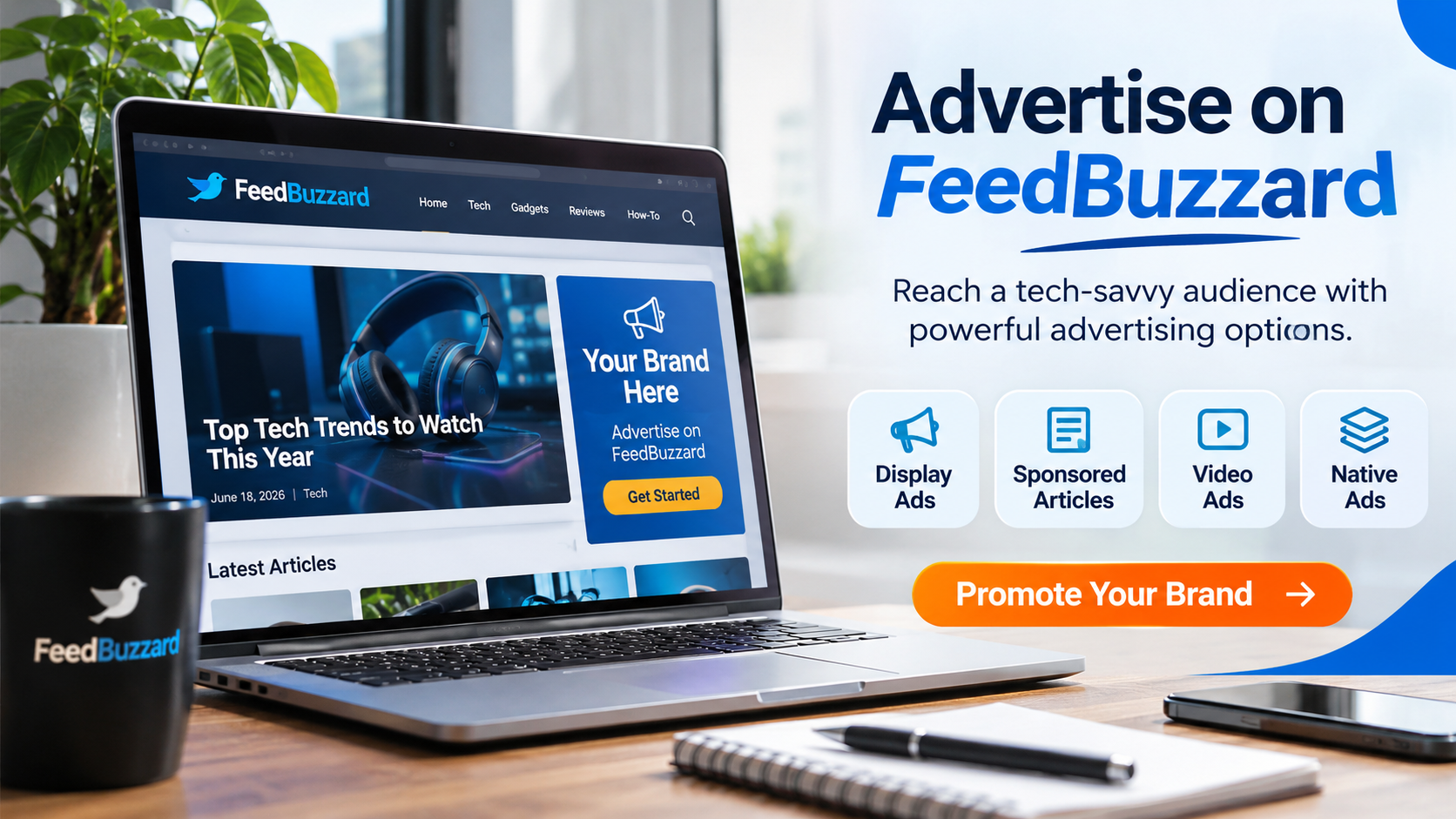
Advertising FeedBuzzard refers to promoting a business, product, or service through advertising opportunities associated with the FeedBuzzard website. The site publishes technology-related content and describes advertising options such as native ads, display banners, video promotions, and sponsored articles. However, its public information does not establish verified advertising prices, audience numbers, or access to a working self-service advertising dashboard. Businesses interested in advertising should contact the publisher, confirm the available services, and review the terms before spending money.
Online advertising can help businesses reach potential customers, introduce products, and build brand awareness. However, finding the right place to advertise is not always simple, especially when a website provides limited information about its advertising services.
FeedBuzzard has attracted attention from marketers looking for alternatives to established advertising networks. Its technology-focused content may appeal to brands that want exposure among readers interested in gadgets, software, digital products, and related subjects.
This guide explains what FeedBuzzard advertising involves, how its advertised features compare with publicly available information, what costs to consider, and how to evaluate whether a campaign makes financial sense.
What Is Advertising FeedBuzzard?
Advertising FeedBuzzard is a term used to describe paid promotional opportunities associated with FeedBuzzard.com.
FeedBuzzard operates as an online content publisher. Its website includes articles about technology, wearable devices, gaming, digital developments, and other topics.
The publisher has also released guides explaining how businesses could promote their products through advertising placements.
In a guide published on June 18, 2026, FeedBuzzard describes several advertising capabilities, including audience targeting, native advertising, banners, video promotions, and sponsored content.
However, a website describing advertising features is not the same as providing independently verified evidence that every feature is currently available.
For businesses, the important distinction is whether FeedBuzzard offers direct advertising placements on its own website, access to a broader advertising network, or both.
That information should be confirmed before purchasing advertising space.
How Does FeedBuzzard Advertising Work?
FeedBuzzard’s published advertising guide describes a campaign process involving account creation, audience selection, creative uploads, budget settings, and performance monitoring.
According to the publisher, advertisers may be able to choose campaign objectives and reach audiences based on interests, location, and other characteristics.
The site also discusses conversion tracking and different advertising payment models.
These descriptions suggest a system similar to other digital advertising services.
However, publicly accessible information does not clearly establish whether businesses can currently complete this process through an operational self-service platform.
A more practical starting point is to contact FeedBuzzard directly and request details about available advertising placements.
Before beginning a campaign, advertisers should understand where their promotional content will appear, who may see it, how long it will remain visible, and what reporting will be provided.
Advertising Formats on FeedBuzzard
FeedBuzzard’s advertising guide mentions several promotional formats. Each serves a different marketing purpose, although advertisers should confirm actual availability and specifications with the publisher.
Native Advertising
Native advertisements are designed to fit naturally within the surrounding content of a website.
For example, a technology company might promote a new software application through an advertisement displayed alongside technology articles.
These placements can attract attention because they match the general layout of the publishing platform.
Native advertisements must still be clearly identified as paid promotions so readers understand their commercial purpose.
Display Banner Advertising
Banner advertisements are visual promotions that commonly appear at the top, side, or within the content of a webpage.
They usually contain an image, a short message, and a link directing visitors to the advertiser’s website.
A recognizable brand image and a clear call to action can make banner advertising useful for awareness campaigns.
However, the actual results depend on placement visibility, audience relevance, and the quality of the advertisement.
Sponsored Articles
Sponsored articles allow businesses to explain a product, service, or subject in greater detail.
A company offering cybersecurity software, for example, might sponsor an educational article discussing common online security mistakes.
This format offers more room for useful information than a typical banner advertisement.
The content should provide genuine value, clearly disclose sponsorship, and avoid misleading promotional claims.
Video Advertising
FeedBuzzard also mentions video advertising in its promotional material.
Video advertisements can demonstrate products, explain services, or introduce a brand through visual storytelling.
Short, understandable videos often work well when viewers can quickly recognize the main message.
Businesses should ask whether video inventory is actually available, which formats are supported, and whether video views can be measured reliably.
Who Can Benefit From FeedBuzzard Advertising?
Advertising on a technology-oriented publisher may be relevant to businesses whose products match the interests of its readers.
Technology brands, software developers, digital service providers, gadget retailers, and companies selling wearable devices are possible examples.
A small business launching a productivity application might want to reach people who regularly read software reviews and technology guides.
Similarly, an electronics retailer could potentially benefit from advertising beside content about consumer gadgets.
Audience relevance matters more than general website popularity.
A publisher with a smaller but genuinely interested audience may sometimes provide better-qualified traffic than a larger website with unrelated readers.
However, this benefit depends on real audience behavior, not assumptions about a website’s subject matter.
FeedBuzzard does not provide enough independently verified public audience data to establish which businesses would achieve the strongest results.
Advertisers should request information about visitor locations, traffic sources, reader interests, and engagement before making that decision.
How to Start Advertising on FeedBuzzard
Starting a campaign should begin with research rather than payment.
Although FeedBuzzard’s published guide describes an account-based advertising process, the availability of that process has not been independently established.
The following approach is more suitable for businesses evaluating an unfamiliar advertising provider.
Step 1: Visit the Official Website
Open FeedBuzzard.com and review its content, advertising information, and contact details.
Pay attention to whether the website’s articles relate to your business and the customers you want to reach.
Step 2: Contact the Publisher
Use the website’s official contact page to ask about advertising opportunities.
Explain what your business sells, which audience you want to reach, and the type of promotion you are considering.
Step 3: Request Advertising Information
Ask for a current media kit, available placements, advertising specifications, audience statistics, pricing, and payment terms.
A useful media kit should explain what the advertiser is purchasing rather than relying on general marketing promises.
Step 4: Choose Your Campaign Objective
Decide whether your priority is website traffic, brand recognition, inquiries, product sales, or another measurable outcome.
A campaign with one clear primary objective is usually easier to evaluate.
Step 5: Prepare Your Advertisement
Create promotional material that communicates the value of your product or service.
Use a clear headline, relevant visuals, and an understandable call to action.
Step 6: Confirm the Agreement
Before paying, obtain written confirmation of the campaign duration, placement, price, reporting arrangements, and cancellation policy.
Step 7: Track the Results
If a campaign begins, monitor its performance using your own website analytics alongside any reports supplied by the publisher.
This process helps reduce uncertainty and gives businesses a clearer basis for deciding whether further advertising is worthwhile.
How Much Does FeedBuzzard Advertising Cost?
There is no independently verified public price list establishing the current cost of advertising on FeedBuzzard.
The publisher’s advertising guide mentions pricing methods such as cost per thousand impressions, cost per click, and cost per install.
However, the guide does not provide confirmed prices, minimum campaign budgets, or package rates.
Understanding common advertising pricing models can still help businesses evaluate any quotation they receive.
Cost Per Thousand Impressions (CPM)
CPM means an advertiser pays for every 1,000 advertising impressions.
This model is generally used when the primary goal is visibility or brand awareness.
For example, at a hypothetical CPM of $8, receiving 20,000 impressions would cost $160.
This is an illustration of how CPM works, not an advertised FeedBuzzard rate.
Cost Per Click (CPC)
Under a CPC arrangement, an advertiser pays when someone clicks the advertisement.
This can be useful for campaigns focused on attracting visitors to a website or landing page.
However, clicks do not automatically translate into customers.
Cost Per Install (CPI)
CPI pricing is commonly associated with mobile application campaigns.
Advertisers pay based on eligible app installations rather than general advertising impressions.
FeedBuzzard mentions this model, but its actual availability should be verified.
Flat-Fee Sponsorship
Some independent publishers also sell sponsored articles or fixed-duration placements for an agreed price.
This can be easier to budget because the advertiser knows the cost in advance.
Whether FeedBuzzard currently offers such arrangements, and at what rates, requires direct confirmation.
How to Choose the Right Budget
A good advertising budget should reflect your business goals and the level of uncertainty involved.
When testing an unfamiliar publisher, committing a large amount immediately can expose a business to unnecessary risk.
A limited initial campaign may provide useful information about traffic quality, customer interest, and conversion performance.
Start by calculating how much your business can reasonably pay to acquire a customer.
For example, if a product generates $40 in contribution profit before advertising, spending $50 to acquire one sale would not be sustainable unless there is a strong reason to expect additional future value from that customer.
Your budget should also account for creative production, landing page improvements, and tracking costs.
The lowest advertising price is not necessarily the best deal. What matters is whether the campaign produces meaningful results relative to its total cost.
Audience Targeting and Reach
FeedBuzzard’s own advertising material describes targeting options based on interests, demographics, location, devices, and customer behavior.
It also mentions reaching English-speaking audiences in countries such as the United States, United Kingdom, Canada, and Australia.
These claims may sound attractive to businesses hoping to expand internationally.
However, the existence of specific targeting controls, audience segments, and geographic reach has not been independently demonstrated through public technical documentation.
Advertisers should therefore request actual audience reports rather than relying on descriptions of potential reach.
For a company selling software to American businesses, for instance, visitors from unrelated countries may provide limited commercial value.
Likewise, a retailer selling products only within one country should avoid paying for traffic it cannot serve.
Geographic relevance, visitor intent, and audience quality are essential considerations when evaluating advertising opportunities.
Creating Effective FeedBuzzard Ads
Even when an advertising placement is suitable, poor promotional content can limit its performance.
A useful advertisement begins by understanding what the intended customer needs.
Instead of making broad statements about a product, focus on a specific benefit.
For example, a project management application might emphasize helping small teams organize deadlines and responsibilities rather than simply claiming to be the best productivity tool.
Use Clear Headlines
A headline should explain the main benefit without exaggeration.
Readers should be able to understand the subject quickly.
Choose Relevant Images
Images should accurately represent the product or service being promoted.
Misleading visuals might attract clicks but can damage trust when visitors reach the destination page.
Make the Next Step Obvious
A call to action should tell readers what happens next.
Phrases such as “View Product Details,” “Explore Features,” or “Request a Demo” provide clear expectations.
Match the Landing Page
The page visitors reach after clicking should deliver what the advertisement promises.
If an ad promotes a specific product, directing visitors to an unrelated homepage can create confusion.
Test Different Messages
If the publisher supports creative testing, compare a small number of genuinely different headlines or images.
Look at meaningful outcomes, not just which version attracts the most attention.
Measuring Advertising Performance
Tracking is one of the most important parts of digital advertising.
Without reliable performance data, it becomes difficult to know whether advertising is generating genuine business value.
Several metrics can help advertisers evaluate a campaign.
Click-Through Rate (CTR) measures the percentage of impressions that result in clicks. A higher CTR may indicate that an advertisement attracts attention, although it does not establish traffic quality by itself.
Conversion Rate measures the proportion of visitors who complete a desired action, such as making a purchase, registering for a service, or submitting an inquiry.
Cost Per Acquisition (CPA) shows how much advertising money is spent to generate one customer or another defined conversion.
Return on Ad Spend (ROAS) compares revenue attributed to advertising with the cost of that advertising.
For example, if a campaign costs $200 and produces $600 in attributed revenue, its ROAS is 3:1.
However, revenue is not the same as profit. Product costs, refunds, operating expenses, and other charges still need to be considered.
Google Analytics also supports UTM parameters, which help identify the campaigns sending visitors to a website.
An advertiser can use a tagged destination URL to distinguish FeedBuzzard referral traffic from visitors arriving through other channels.
Independent measurement is particularly valuable when the publisher has not established a publicly verifiable reporting system.
Benefits of FeedBuzzard Advertising
There are potential advantages to exploring advertising with a smaller content publisher, provided the available placements and audience quality can be verified.
Relevant Content Environment
Technology-related businesses may find value in advertising alongside articles that discuss digital products and consumer technology.
Potential Brand Exposure
A suitable advertising placement can introduce a business to readers who may not already know its products.
Room for Direct Negotiation
If the publisher sells advertising directly, businesses may be able to discuss placement arrangements and campaign terms with the site operator.
Content-Based Promotion
Sponsored content, where available, can give advertisers space to explain practical benefits instead of relying on a short visual message.
These are potential advantages of publisher advertising rather than confirmed performance benefits specific to FeedBuzzard.
Actual value depends on the audience, advertising price, placement quality, and measurable campaign results.
Risks and Limitations
FeedBuzzard advertising also raises questions that businesses should consider before committing money.
The most important concern is the limited availability of independently verifiable information about the advertising operation.
Its public advertising material describes features such as real-time bidding, automated targeting, and campaign reporting.
However, public documentation does not clearly demonstrate a functioning advertiser dashboard or provide independently audited evidence supporting those capabilities.
Other limitations include the absence of a verified public rate card, limited visibility into historical campaign performance, and insufficient public audience statistics.
The site’s contact page also displays an unusual address that does not, by itself, establish a verifiable business location.
None of these observations proves that the publisher is fraudulent or unable to provide advertising services.
Small websites sometimes manage legitimate sponsorships directly without sophisticated advertising systems.
Nevertheless, businesses should verify the identity of the advertising seller, confirm the agreed deliverables, and use traceable payment methods.
A professional advertising agreement should explain what the customer receives and what happens if the placement is not delivered.
Is FeedBuzzard Advertising Legitimate?
FeedBuzzard.com is an accessible content website with published articles and advertising-related information.
That establishes the existence of the publisher, but it does not independently verify every claim made about its advertising capabilities.
As of November 2026, the publicly reviewed material does not provide enough evidence to confirm a fully operational self-service advertising network with documented pricing and independently verified performance statistics.
This does not mean that every advertising opportunity associated with the site is unreliable.
It means that advertisers should distinguish between published promotional claims and services that can actually be demonstrated.
Before transferring funds, request a written proposal, proof of the advertised placement, relevant traffic evidence, and clear reporting commitments.
If a seller cannot explain exactly what will be delivered, consider alternative advertising options.
FeedBuzzard vs. Other Advertising Platforms
FeedBuzzard should not automatically be considered equivalent to established digital advertising networks.
Platforms such as Google Ads and Meta Ads provide documented advertising systems, campaign creation tools, targeting options, and performance reporting.
Native advertising providers such as Taboola and Outbrain also publish information about their advertising products and campaign management processes.
FeedBuzzard, by comparison, presents advertising capabilities in its own articles but provides less publicly verifiable operational detail.
The difference matters when choosing a marketing channel.
A business seeking broad reach, detailed campaign controls, or established reporting tools may prefer a documented advertising platform.
A company exploring niche publisher sponsorships might still investigate FeedBuzzard if its audience and placement terms can be verified.
The best choice depends on advertising objectives, customer relevance, reporting needs, and budget.
Sponsored Content and SEO
Some businesses consider sponsored articles because they want both referral traffic and improved search visibility.
However, paid content should not be treated as a guaranteed method for increasing Google rankings.
Google’s Search Central documentation recommends identifying paid links with the rel="sponsored" attribute. The nofollow attribute is also accepted.
Buying links primarily to manipulate search rankings can violate Google’s spam policies.
For this reason, businesses should judge sponsored articles based on their usefulness to readers, transparency, and potential to introduce genuinely interested visitors.
A high-quality sponsored article should answer real questions, provide accurate information, and disclose its commercial relationship.
The United States Federal Trade Commission also advises that native advertising should be clearly recognizable as advertising when its presentation might otherwise mislead consumers.
Advertisers operating in other countries should consider the disclosure and consumer protection rules that apply to their markets.
Common Advertising Mistakes to Avoid
One common mistake is choosing an advertising provider based only on its marketing claims.
Statements about advanced targeting or large audiences are not enough to establish campaign quality.
Another mistake is purchasing advertising without defining a measurable goal.
If a campaign is intended to generate sales, impressions alone cannot tell the advertiser whether it succeeded.
Businesses should also avoid sending visitors to slow, confusing, or irrelevant landing pages.
Even valuable traffic can perform poorly when the destination website does not provide a clear user experience.
Ignoring tracking is another costly error. Without independent measurement, advertisers may struggle to separate useful visitors from accidental clicks or low-quality traffic.
Finally, paying for a campaign without a written agreement creates unnecessary uncertainty about placement, duration, refunds, and reporting.
These mistakes are not unique to FeedBuzzard. They apply to nearly every form of online advertising.
How to Decide Whether FeedBuzzard Is Worth It
Whether FeedBuzzard advertising is worth considering depends on the quality of the actual offer.
The first question is whether its audience matches the customers your business wants to reach.
The second is whether the publisher can provide reliable information about visitor numbers, placement locations, and expected advertising delivery.
The third is whether the quoted price makes financial sense when compared with other available channels.
A useful proposal should answer several straightforward questions: Where will the advertisement appear? How long will it run? What traffic or placement data supports the offer? What results will be reported? What happens if the agreement is not fulfilled?
If these questions receive clear, verifiable answers, a limited campaign may be worth testing.
If the information remains unclear, advertisers have good reason to avoid committing a substantial budget.
The best advertising decision is based on documented value, not the number of features mentioned in promotional material.
Frequently Asked Questions
1. What is Advertising FeedBuzzard?
Advertising FeedBuzzard refers to paid promotional opportunities associated with FeedBuzzard.com. The publisher describes options such as native advertisements, banners, videos, and sponsored articles, although current availability and operating details require confirmation.
2. How can I advertise on FeedBuzzard?
Visit FeedBuzzard.com and use its official contact page to inquire about advertising. Ask for available placements, audience statistics, pricing, creative requirements, and written campaign terms before making a payment.
3. Is FeedBuzzard advertising free?
No verified free advertising program has been established. The site describes paid advertising models but does not publish a confirmed public price list. Businesses should request written pricing directly from the publisher.
4. How much does advertising on FeedBuzzard cost?
The current cost cannot be reliably determined from publicly available information. FeedBuzzard mentions CPM, CPC, and CPI models without verified rates or minimum budgets. Ask for a written quotation based on your requirements.
5. Does FeedBuzzard support sponsored posts?
FeedBuzzard’s advertising guide mentions sponsored articles. However, advertisers should confirm whether sponsored post opportunities are currently offered, what editorial guidelines apply, and how the posts will be labeled.
6. Is FeedBuzzard a legitimate advertising platform?
FeedBuzzard.com is a functioning content website, but publicly available evidence is insufficient to independently verify the full advertising platform described in its promotional material. Businesses should confirm operational details and payment terms before purchasing services.
7. Who should consider FeedBuzzard advertising?
Technology companies, software providers, electronics retailers, and related businesses may consider exploring it if the publisher can demonstrate a relevant audience. The suitability of a campaign depends on actual readership and placement quality.
8. Can FeedBuzzard advertising increase website traffic?
An advertising placement can generate website visits when readers click through to the advertiser’s page. However, there is no verified guarantee of how much traffic FeedBuzzard can deliver. Advertisers should use tracked links to measure actual visits.
9. Does FeedBuzzard provide audience targeting?
Its published advertising material describes targeting by location, interest, demographic characteristics, and other factors. The current operation and availability of these features have not been independently confirmed.
10. Can FeedBuzzard advertising improve SEO rankings?
Paid advertising does not directly guarantee higher organic search rankings. Sponsored content may generate referral traffic and brand awareness, but paid links should follow Google’s guidelines, including appropriate sponsored link attributes.
11. How do I measure FeedBuzzard advertising results?
Use website analytics, campaign-specific UTM links, and conversion tracking where appropriate. Monitor relevant metrics such as visitors, conversions, acquisition costs, and revenue. Compare your independent results with any publisher reports.
12. Is FeedBuzzard better than Google Ads?
There is not enough verified performance data to conclude that FeedBuzzard is better than Google Ads. Google Ads offers a documented self-service advertising system, while FeedBuzzard’s operational advertising capabilities need further verification.
Final Thoughts
Advertising FeedBuzzard may interest businesses that want to explore promotional opportunities on a technology-oriented website.
The publisher describes several advertising formats and targeting capabilities, but the absence of verified public pricing, audience statistics, and operational documentation makes careful evaluation essential.
Before investing, businesses should request detailed information about the available placements, confirm the audience, establish clear campaign goals, and agree on measurable deliverables.
For companies with limited marketing budgets, testing a small, clearly documented placement is generally more sensible than committing substantial funds to an unverified offer.
Ultimately, successful advertising depends on reaching the right people, delivering a useful message, and measuring genuine business results. Whether FeedBuzzard can contribute to those goals should be determined through verified information and actual campaign performance.
Sources and Further Reading
The following sources provide the basis for the platform-specific information and advertising guidance discussed in this article.
- FeedBuzzard — Official Advertising Guide — The publisher’s description of advertising formats, targeting, pricing models, and campaign setup.
- FeedBuzzard — Official Contact Page — Public contact information for inquiries about the website.
- Federal Trade Commission — Native Advertising Guide — Guidance on transparent advertising and commercial content disclosures.
- Google Search Central — Qualify Outbound Links — Google’s recommendations for identifying sponsored links.
- Google Analytics — Campaign URL Parameters — Official documentation on tracking campaign traffic using UTM parameters.
- Entrepreneurship Life — Advertising on FeedBuzzard — Independent discussion of FeedBuzzard’s publicly visible advertising information and verification concerns.