
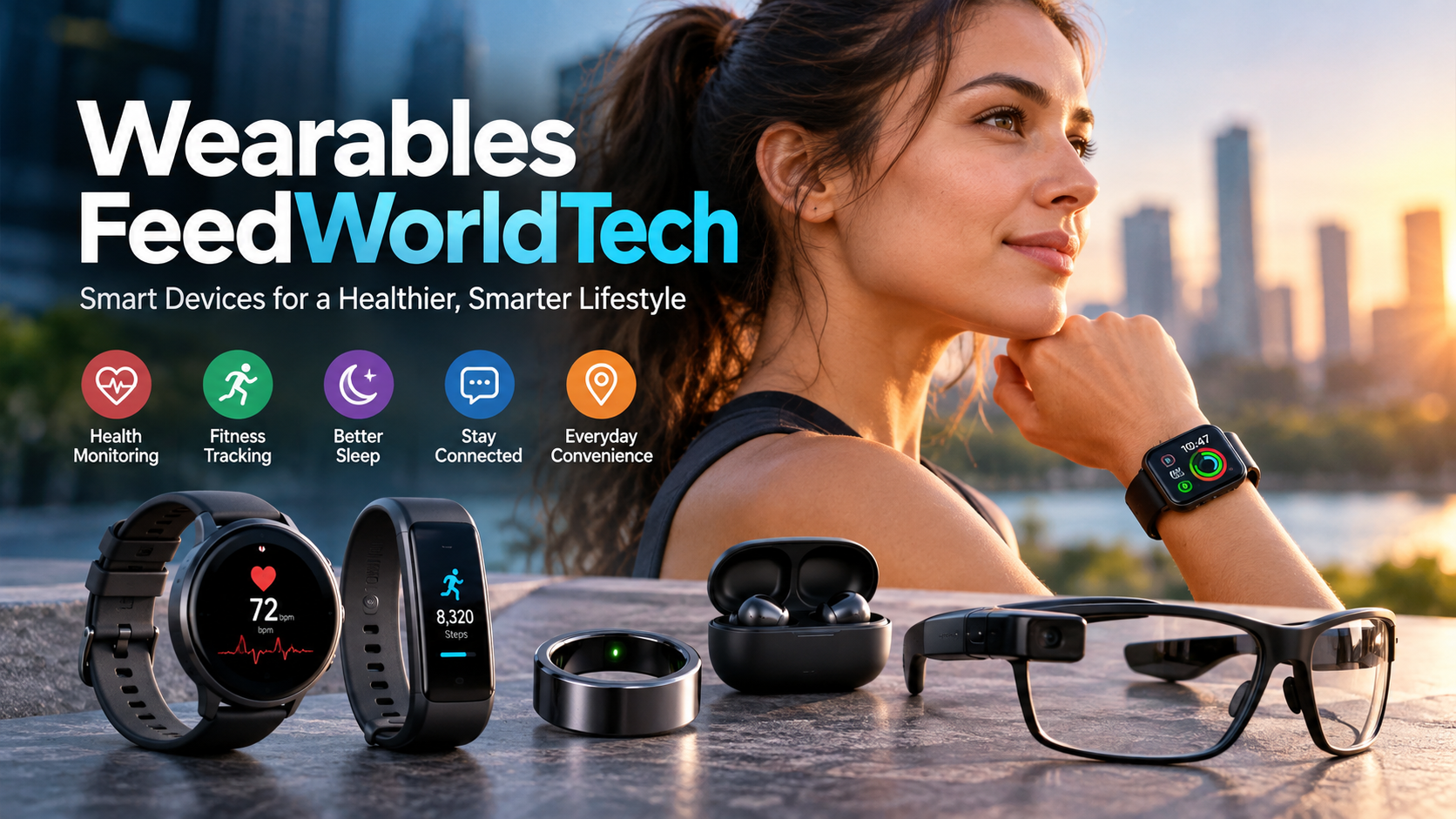
Wearable technology has changed how people track their fitness, monitor everyday health patterns, and stay connected without constantly checking their phones. The term wearables FeedWorldTech is associated with technology articles covering smartwatches, fitness trackers, smart rings, and other connected devices. Rather than identifying a particular gadget, it points to a broader discussion about wearable innovation and its practical uses. These devices can provide helpful information, but their capabilities differ considerably. Understanding their sensors, accuracy, smartphone compatibility, and privacy features makes it easier to separate useful technology from exaggerated promises and choose a wearable that suits your lifestyle.
What Is Wearables FeedWorldTech?
Wearables FeedWorldTech refers to wearable technology coverage associated with websites publishing under the FeedWorldTech name.
The website FeedWorldTech.org has published articles discussing smart devices, fitness monitoring, connected accessories, and digital health. Similarly, FeedWorldTech.net describes wearable gadgets and technology developments as part of its editorial coverage.
The phrase is therefore best understood as a technology-related content topic, not the official name of a smartwatch, operating system, or wearable hardware manufacturer.
Its central subject is wearable computing: electronic equipment designed to be worn on the body while collecting information, performing specific tasks, or communicating with other devices.
How Modern Wearable Technology Works
Most smart wearables combine compact sensors, processors, batteries, and wireless connections. Their software interprets collected signals and presents the results through a screen or companion smartphone application.
Three important technologies make many of these features possible.
Motion Sensors and Activity Tracking
Accelerometers detect movement and changes in orientation. They help devices estimate steps, identify physical activity, and recognize certain movement patterns.
Some wearables also use gyroscopes and GPS technology to provide additional exercise information, such as movement direction, outdoor routes, and estimated distance.
Step counts are useful for comparing daily activity, although different devices may produce different readings during the same activity.
Optical Heart Rate Monitoring
Many smartwatches and fitness bands use photoplethysmography, commonly called PPG.
This technology shines light into the skin and measures changes in reflected light caused by variations in blood volume. Software processes these signals to estimate heart rate.
A scientific guide to consumer wearables explains how optical sensors, motion detection, and electrocardiography support cardiovascular monitoring.
Measurements can be affected by movement, device positioning, and individual characteristics.
Smartphone Connectivity
Bluetooth allows many wearables to exchange information with a smartphone. Some models also support Wi-Fi or cellular connections.
This connectivity enables features such as message notifications, exercise synchronization, navigation, and software updates.
However, the amount of functionality available without a phone depends on the device and its connectivity options.
Types of Wearable Devices Covered by FeedWorldTech
Wearable technology includes several distinct product categories. Each offers different benefits, so choosing the right format is often more important than purchasing the most expensive device.
| Wearable Type | Main Functions | Best Suited For |
|---|---|---|
| Smartwatches | Notifications, exercise tracking, applications, navigation | Everyday connectivity and fitness |
| Fitness trackers | Step counting, workout records, activity goals | Exercise and daily movement |
| Smart rings | Sleep estimates, activity and selected physiological measurements | Discreet, screen-free monitoring |
| Smart glasses | Hands-free information, cameras or visual displays on supported models | Communication and specialized tasks |
| Smart earbuds | Audio, calls, voice assistants and selected sensor features | Listening and hands-free interaction |
| Medical wearables | Condition-specific measurements and monitoring | Clinical needs under appropriate guidance |
The final category requires an important distinction. A medically authorized monitoring device is not interchangeable with a general-purpose fitness accessory.
What Wearables Can Really Tell You About Your Health
Health monitoring is among the most useful applications of modern wearable technology. However, displaying a measurement does not automatically make a device suitable for medical decisions.
Fitness and Heart Rate Measurements
Heart rate trends can help users review exercise intensity and recovery patterns. Activity records can also support personal fitness goals.
A 2024 umbrella review published in Sports Medicine analyzed 24 systematic reviews concerning consumer wearable accuracy.
It found that reliability differed by measurement type, device, and testing conditions. Heart rate tracking generally performed better than some estimates of activity intensity and energy expenditure.
This means a wearable may be helpful for observing changes over time without delivering laboratory-level precision.
Sleep Tracking
Smart rings and fitness trackers commonly estimate sleep duration, sleeping patterns, and periods of wakefulness.
Most consumer products calculate these results using combinations of movement, heart rate, and other sensor data rather than directly measuring brain activity.
Sleep-stage classifications should therefore be treated as estimates. Persistent sleep problems deserve proper clinical evaluation, regardless of what a wearable displays.
Blood Glucose and Medical Claims
Blood glucose monitoring requires particular caution.
In February 2024, the U.S. Food and Drug Administration issued a safety communication about smartwatches and rings claiming to measure blood glucose independently without piercing the skin.
“Do not buy or use smartwatches or smart rings that claim to measure blood glucose levels.” — U.S. Food and Drug Administration
The warning concerns independent, non-invasive glucose measurement claims. It does not prohibit smartwatch applications from displaying readings supplied by authorized continuous glucose monitoring systems.
People who need glucose measurements for medical treatment should use appropriate authorized equipment and follow professional guidance.
Choosing the Right Wearable Device
The best wearable is the one that performs the tasks you need comfortably and reliably.
Before purchasing, consider these factors:
- Smartphone compatibility: Confirm that the wearable supports your phone’s operating system and software version.
- Battery life: Compare the manufacturer’s stated battery performance with your charging habits and intended features.
- Sensor accuracy: Look for independent testing of the measurements that matter most to you.
- Comfort and fit: Choose a size and design suitable for prolonged wear, especially overnight.
- Subscription costs: Check whether detailed insights or additional services require recurring payments.
- Software support: Review update policies, application availability, and any restrictions in your country.
Compatibility deserves special attention. Apple Watch setup depends on compatible iPhone hardware and software, while Google’s Pixel Watch products are designed for supported Android phones.
A product with excellent features may still be the wrong choice if it cannot connect properly to your existing devices.
Privacy and Security in Wearable Technology
Smart wearables can collect sensitive information, including movement history, location data, heart rate measurements, and sleep patterns.
Many products synchronize this information with mobile applications or cloud accounts.
The Federal Trade Commission explains that some consumer health applications and connected devices fall outside the U.S. HIPAA framework, although other privacy and consumer protection requirements may apply.
Before activating a new wearable, review its data collection practices, application permissions, and sharing controls.
Users should also check whether they can export or delete their information, enable account security protections, and control connections with third-party services.
A device’s privacy practices deserve as much attention as its sensors and display.
When Is a Wearable Upgrade Worthwhile?
Wearable improvements are not always obvious from a specification sheet. A newer device may offer additional sensors, updated software, or more convenient charging without substantially changing the owner’s daily experience.
An upgrade makes the most sense when it solves a specific problem.
Someone with an unreliable battery may benefit from a device with longer endurance. A runner might prioritize stronger GPS functionality, while a person who dislikes wrist-worn screens may prefer a smart ring.
Before replacing a functioning wearable, check whether a software update can provide the desired improvement. It is also sensible to consider whether switching manufacturers will affect access to existing activity and health records.
Frequently Asked Questions
1. What does wearables FeedWorldTech mean?
Wearables FeedWorldTech is a term associated with FeedWorldTech’s editorial coverage of wearable technology. It includes topics such as smartwatches, fitness bands, smart rings, wearable health monitoring, and connected accessories.
2. Does FeedWorldTech manufacture smartwatches or fitness trackers?
FeedWorldTech presents itself as a technology-information publisher. Its wearable-related articles explain devices and technology developments rather than establishing it as a manufacturer of branded wearable hardware.
3. Are smart rings better than smartwatches?
Neither category is universally better. Smart rings suit people who prefer discreet, screen-free tracking, while smartwatches generally offer more interactive features such as displays, notifications, navigation, and applications.
4. Can wearable devices accurately monitor health?
Accuracy depends on the device, sensor, and measurement. Some wearables provide useful heart rate and activity information, but sleep estimates and other health metrics can contain substantial errors. Consumer wellness devices should not replace appropriate medical equipment.
5. Can wearable devices work without a smartphone?
Certain features can function independently, including basic activity recording and some on-device functions. Initial setup, synchronization, software updates, or advanced communication may still require a compatible smartphone. Cellular-enabled models can offer additional independence.
6. What should beginners consider when buying a wearable?
Beginners should prioritize their intended use, comfort, phone compatibility, battery life, and total cost. A basic fitness tracker may be sufficient for daily activity goals, whereas a smartwatch may be more suitable for communication and applications.
Conclusion
Wearables FeedWorldTech is best understood as a topic connected to wearable technology coverage, not as a standalone device or product line. Its subject spans smartwatches, fitness trackers, smart rings, connected accessories, and health-monitoring technology.
Wearables can make everyday information more accessible and help users understand personal activity patterns. Their value, however, depends on reliable features, responsible data handling, and realistic expectations.
Choosing a device based on practical needs rather than marketing claims remains the most effective way to benefit from wearable technology.
Read also How to Update ETSJavaApp by eTrueSports: A Safe Step-by-Step Guide